
As a certified Celebrant for funerals and celebrations of life, I am often asked to officiate a service because a family or their loved one was not affiliated with a formal religion or church. Most often, the family still holds some belief that they will see their loved one again—that there is a heaven where they will be reunited.
They may also believe in spiritual symbolism: a butterfly, a dragonfly, or an eagle reminding them of their loved one. These symbols can feel like a form of communication between them.
Then there was the time I met a family who very clearly said, “He was an atheist,” when I asked about their loved one.
His wife explained that her husband had once undergone a medical procedure during which he experienced what he described as a state of non-existence. That experience led him to believe that once the physical body dies, life in all forms is complete.
He told his family that his request after death was simple: keep sharing stories about him. If people continued to remember and talk about him, his existence would continue. Only when there was no one left to remember would his existence truly cease.
After meeting this family and officiating that celebration of life, I began to ponder something deeper:
How does one grieve when their loved one was an atheist—or when the grieving family does not believe in an afterlife?In these moments, grief can take on a different shape.
Not worse.
Not less meaningful.
Just different.
Families sometimes struggle with how to honor someone who did not hold religious beliefs. Traditional funerals often revolve around spiritual themes such as heaven, angels, and eternal life. When those ideas do not reflect the person who died, the ceremony can feel disconnected from their life.
Instead, secular memorials often focus on something profoundly human: the story of a life.
Friends share memories.
Children talk about lessons learned.
Music reflects personality.
Stories fill the room with laughter and tears.
The focus shifts from where the person has gone to how they lived while they were here.
And that is deeply beautiful.
For families who do not believe in an afterlife, grief can also include confronting the finality of death. There may not be a belief that they will meet again someday, but that does not mean there is no connection.
Continuing Bonds
Many secular grievers find comfort in what psychologists call continuing bonds—the ways we carry the person forward in our lives.
Just like the man who asked his family to continue remembering him because that was proof that he had existed.
Some ways to create continuing bonds may include:
- Creating memory projects or legacy activities
- Celebrating birthdays or anniversaries with storytelling
- Contributing to causes meaningful to the loved one
- Passing on their values to children and family members
- Integrating their lessons into daily life
In this way, love continues even when life does not.
The Healing Power of Legacy
When belief in heaven is not part of the grieving framework, something else often becomes central: legacy.
What did this person stand for?
How did they change the lives of others?
What parts of them now live on through the people they loved?
Grief becomes not only about loss but also about stewardship of a life that mattered.
Compassion Across Belief Systems
One of the most important things we can do for grieving people is respect their belief system.
Well-intended religious statements may comfort some, but for others they may feel isolating.
Sometimes the most healing thing we can say is simply:
“I’m so sorry. Please tell me about them.”
Because in the end, grief is not primarily about theology.
It is about love.
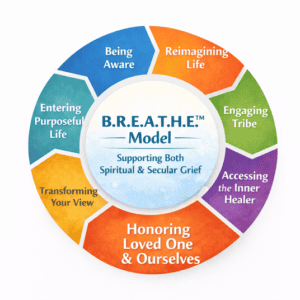
In grief coaching and bereavement support, it is essential to provide frameworks that respect diverse belief systems. One such framework is our B.R.E.A.T.H.E. Coaching Model for Grief™, which supports both spiritual and secular grieving individuals by focusing on meaning-making, connection, and honoring the life of the loved one.
This model offers a flexible structure that supports mourners regardless of spiritual orientation.
For secular mourners, the model provides language and practices that do not require belief in spiritual continuation while still supporting profound emotional healing.
Honoring as an Act of Love
The “H” in the B.R.E.A.T.H.E. model stands for Honoring Our Loved One and Ourselves.
This has proven especially meaningful for individuals who do not frame grief through religious beliefs.
Through intentional thoughts and actions that resonate with family and friends, the loved one’s influence continues in tangible and meaningful ways.
Rather than focusing on where the person is believed to be, secular grieving often emphasizes how their life continues to shape the world around them.
Ultimately, grief is not defined by belief systems but by relationships.
Whether expressed through faith, memory, or legacy, the core of grief is love.
Honoring our loved ones allows that love to remain active in our lives. It invites us to carry forward the wisdom, values, and impact of those who shaped us.
For secular mourners, honoring may become one of the most powerful ways to maintain connection.
Not through spiritual reunion.
But through the lived continuation of a life that mattered.
And in that continuation, love endures.